

Whole Plasmid Sequencing FAQs
Sample Preparation
What types of samples should I prepare for Plasmid-EZ?
Please submit purified plasmid DNA at a concentration of 20-200 ng/μL in a minimum volume of 10 μL in water or elution buffer. We also recommend a 260/230 ratio of 2.0-2.2 and 260/280 ratio of 1.8-2.0.
Samples should be prepared in microcentrifuge tubes, sealed 96-well plates, or capped PCR strip tubes. We will perform linearization upon receipt of plasmid DNA samples followed by library preparation and sequencing.
Should I use Nanodrop or Qbit to measure the concentration?
We recommend using Qubit as NanoDrop® cannot distinguish between dsDNA and ssDNA (oligos and dNTPs) and may cause you to overestimate the amount of dsDNA in your samples.
How should I prepare the tubes/plates?
Tubes for <48 Samples
If you are submitting <48 samples, please use 8-strip, 0.2 ml PCR tubes and caps. You can cut off empty tubes and use them next time.
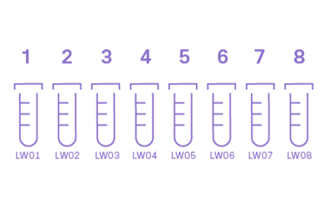
GENEWIZ’s Online Ordering System will assign tube ID codes using your initials and the sample number (see Figure to the right). Please write these codes on the sides of your tubes using an indelible marker.
Label the side of your tubes with YOUR initials and sample number. These should match your order receipt.
Plates for >48 Samples
If you are submitting 48 or more samples, we recommend using a 96-well, semi-skirted PCR plate. Cap the wells with 8-strip caps. These are usually ordered separately from the plates. Be sure that the caps seal tightly! The semi-skirted plate helps to prevent the plate from bending in transit, resulting in fewer loose caps. Please ship the plate with cushioning to avoid potential damage.
Please contact us for help finding a vendor if your laboratory does not have any 96-well PCR plates or matching strip caps.
Arrange your samples vertically or horizontally. Please ensure that the plate orientation matches the order form well orientation.
What is the size range of plasmids that I can prepare for sequencing?
Plasmids up to 25 kb can be sequenced using this workflow. If you are sequencing larger than 25 kb, please contact DNAseq@azenta.com for a technical consultation.
Can a mixture of plasmids be submitted for sequencing using this service?
This service is intended for a clonal population of plasmids. If plasmid pools or mixtures are submitted, the sequencing and analysis results cannot be guaranteed.
What happens if my samples do not meet your starting material requirements?
Please contact DNAseq@azenta.com for technical consultation.
Sample Submission
When should I submit samples?
Samples may be submitted at any time. Samples must be received in the morning at our facility to be eligible for that day’s cycle. Projects with incomplete information may be placed in the next sequencing cycle. Results are delivered on the same day in select regions or in as fast as 1 business day.
What are the sample submission guidelines for Plasmid-EZ?
Sample Type: Purified Plasmid DNA
Size: Up to 25 kb; if larger than 25 kb, please reach out to DNAseq@azenta.com.
Concentration: 20-200ng/μL in a minimum volume of 10μL. We recommend performing DNA quantification assay with Qubit or equivalent fluorometric method such as a plate reader (note: spectrophotometric methods like Nanodrop are much less accurate!).
Purity (A260/280): 1.8-2.0 and (260/230): 2.0-2.2
Buffer: Water, EB, or low TE (<0.1 mM EDTA)
How can I send my samples to GENEWIZ?
Please send your samples, along with a copy of your order receipt, to us using one of the following options.
Option #1: Submit samples into a local dropbox at room temperature. We have an extensive network of convenient dropboxes located throughout the US. To find a dropbox near you, please contact DNAseq@azenta.com.
Option #2: Ship samples directly to our NJ facility using the shipping address listed on your order receipt. You can ship at room temperature or on blue/dry ice.
What are the cutoff times for my dropbox pickup?
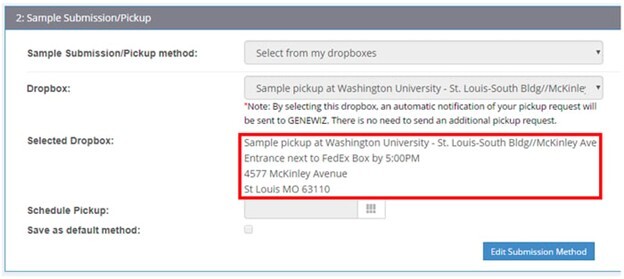
When submitting an order in our customer portal, the final step is to locate a dropbox closest to your institution; please choose the dropbox you will leave your sample at for Plasmid-EZ. During checkout, consult the Order Summary page to find out the daily cutoff times for your selected dropbox (see example below).
Ordering & Processing
How do I order Plasmid-EZ?
You can order Plasmid-EZ in minutes without a quote. Check out the Plasmid-EZ Order Guide for the 9 easy steps.
How much sequencing coverage is expected per plasmid?
Coverage is highly dependent on sample quality as determined by the end-user prior to sample submission and therefore cannot be guaranteed. If you have any questions or need troubleshooting assistance, please contact DNAseq@azenta.com.
How can I monitor the progress of my Plasmid-EZ project?
The estimated delivery date for your order can be viewed anytime through our customer portal on the Order Summary page. Because of the fast turnaround time of the service, we do not provide detailed project updates (i.e., timestamps for QC, library preparation, sequencing, and data analysis).
How do I cancel or discard my Plasmid-EZ-EZ order?
- If your order is in ‘Waiting for Sample’ or ‘Submitted’ status, you can select the order on your home page and click ‘Delete’. GENEWIZ only charges for samples we process and if your samples have not been received by our lab, you can cancel the request and no charges will be applied.
- If you never submitted your samples to GENEWIZ, there is no other action required!
- If you shipped your samples or placed them in the dropbox, please contact DNAseq@azenta.com and let us know that you intentionally cancelled the sequencing request.
- If you need to cancel your sequencing request and your order is NOT in ‘Waiting for Sample’ or ‘Submitted’ status, please reach out to DNAseq@azenta.com; a cancelation fee may apply if your samples have reached the ‘Processing’ status.
What do the different order statuses mean?
- Waiting for sample – the order has been created and GENEWIZ is awaiting receipt of the starting material
- Received – the order has arrived at our laboratory
- Processing – our laboratory staff have initiated processing and the order is actively being prepared for sequencing, sequenced, or pending data delivery
- Completed – data has been delivered and the order is available to be invoiced, based on the work completed
My order has been in ‘Received’ or ‘Processing’ status longer than I expected. What should I do?
It is possible the lab may have run into issues that could lead to delays in processing (e.g. sample discrepancy, insufficient volume, etc.). Please check the email address associated with your GENEWIZ account for updates. If there are no updates, please contact DNAseq@azenta.com and let us know that you intentionally cancelled the sequencing request.
Are there any limitations on sample names?
Sample names can only contain letters, numbers, dashes “-“, or underscores “_”
Yes, there are words that cannot be used as sample names. Certain reserved words cannot be used as the entire sample name including:
- All
- Unknown
- Undetermined
- Na
- Nan
- None
- Null
These terms may still appear within a longer same name. For instance, null_unknown is an acceptable name.
How much will my order cost and how can I request a quote?
The cost of your order can vary depending on the sample quantity and any institutional discounts you are eligible for.
To determine the cost and print a quote, first create a draft of your order, then click on “Save and Review”, and then click on “Print Quote”.
Here is our CLIMS Print Price and Dropbox Management Guide. Just follow the steps to print the price of your order.
Can I edit my sample names or change the reference sequence after placing my order?
You can edit sample names or the reference sequence until your order enters ‘Processing’ status. From your account homepage, click the checkbox next to the respective 30-xxxxxx tracking number and then click ‘Edit’.
While you can edit the sample names and reference sequences, you cannot change the quantity of samples with your order. If you need to make changes to your order that impact the number of samples being processed, please contact DNAseq@azenta.com.
What is the turnaround time?
For customers located near one of our six overnight sequencing labs, you will receive results by 8 AM the next morning.
For customers who ship samples to our New Jersey facility, results will be available by the evening of the day that the samples are received.
Does GENEWIZ perform QC on my Plasmid-EZ samples prior to library preparation?
No, we do not perform sample QC. This enables us to provide rapid and cost-effective service for whole plasmid sequencing. Prior to submission, please measure the concentration of your samples (preferably using a dsDNA quantification assay such as Qubit or PicoGreen) and submit samples within a range of 20-200ng/μL.
Can GENEWIZ perform plasmid DNA preparation for me?
Plasmid preparation can be ordered after the Plasmid-EZ results are available. We will retain your submitted plasmid DNA samples for downstream plasmid preparation.
To order plasmid preparation, navigate to your results page, and in the ‘Sample Details’ section, select the sample(s) you want to order, and click ‘Submit Prep Order’. This will open a new page, and you can create the plasmid DNA preparation order.
Additionally, you can submit plasmid preparation order and choose to do Plasmid-EZ as sequence verification for your plasmid.
What is Sanger validation?
Sanger validation allows targeted confirmation of a specific region of interest while whole plasmid sequencing is performed in parallel. This option can be useful when a critical region requires independent verification.
When you create your order, check the box that you want Sanger validation and enter the primer you intend to use; when you check out your Plasmid-EZ order, a separate, related Sanger order will be created. Please print off BOTH order forms and submit them with your sample (and primer if you are submitting a primer).
Results
How do I interpret my results?
Our Plasmid-EZ Quick Start Guide provides an overview of each result file and explains how to interpret your results.
If you have additional questions, please reach out to DNAseq@azenta.com.
Can Plasmid-EZ detect plasmid multimers?
Sometimes, multiple plasmid copies combine via homologous recombination to produce a multimeric form of plasmid with repeating sequences. This process is called plasmid multimerization. Plasmid-EZ is an effective way to detect such multimers; it generates exceptionally long reads that can detect large repeat sequences within a plasmid. However, if there are multimers that are present at a higher proportion in the sample, they can cause misassembly.
What data output will I receive for Plasmid-EZ?
You will receive an interactive data report, consensus sequence of your plasmid(s) in FASTA format, raw reads in FASTQ files, GenBank files, ab1 files, variation files, and annotation files, including plasmid map images. If a reference sequence is provided, then we will also provide an alignment file and variation files highlighting any differences between the consensus sequence and reference sequence.
How do I download my data?
Once data analysis is complete, you will receive an email that the order is completed. Log in to your GENEWIZ account. Click on “View results” tab of the order and download the results. The results will be downloaded as zipped files.
Is there additional bioinformatics available?
All custom bioinformatic analysis requests are taken on a case-by-case basis after a technical consultation with one of our technical support scientists. Please contact DNAseq@azenta.com for questions.
Troubleshooting
What if my plasmid samples fail to assemble?
It is likely that sequencing failure, i.e., failure of the sample to produce consensus sequence with 10x coverage or less, may be due to samples not prepared at the required DNA concentration, containing a mixed plasmid population, or degraded/fragmented DNA.
Can Plasmid-EZ detect plasmid multimers?
Sometimes, multiple plasmid copies combine via homologous recombination to produce a multimeric form of plasmid with repeating sequences. This process is called plasmid multimerization. Plasmid-EZ is an effective way to detect such multimers; it generates exceptionally long reads that can detect large repeat sequences within a plasmid. However, if there are multimers that are present at a higher proportion in the sample, they can cause misassembly.
To achieve optimal sequencing results, please follow our recommended sample submission guidelines.
What if my results do not match my expectations or hypothesis?
We cannot guarantee the results of the sequencing data. If you feel that a processing error may have occurred, please contact DNAseq@azenta.com and we will investigate.
I have a region of interest that requires additional verification. What are my options?
You can order targeted Sanger sequencing from the Results page of your Plasmid-EZ order. First click ‘View Results’. Next, select the samples you want to sequence and click ‘Submit Sanger Order’. This will open a new page, and you can create the Sanger sequencing request. If you need to submit the primer for Sanger sequencing, after you check out, print out your order form, attach the primer, and send us your material.
Colony-EZ
What is Colony-EZ?
Colony-EZ is our whole plasmid sequencing service, starting from bacteria instead of purified plasmid. We will isolate your plasmid preparation prior to sequencing for an added charge.
How do I submit my bacteria?
You can submit your bacteria in several different ways!
- Bacterial colonies: Plate colonies on agar plates. Circle and number colonies or leave blank for random pick. Wrap agar plates in parafilm and provide a cushion to protect against potential damage. If the colonies are too small or not visible, we will contact you and incubate the plate overnight at 37°C before processing, resulting in a delay of one day.
- Liquid culture: 100μL of overnight-grown liquid culture (8 to 16 hours), shipped in 200μL strip tubes. If the culture is not dense, we will contact you and grow the culture overnight at 37 °C before processing, resulting in a delay of one day.
- Colonies picked in water: Pick 1 large colony in 10μL H2O only (no media). Samples should be visibly cloudy. Please note, if the plasmid is low copy, submitting colonies picked in H2O might fail sequencing.
- Glycerol stock: The sample submitted should be cloudy. If the liquid is not cloudy, we will contact you and will incubate the sample overnight at 37°C before processing, resulting in a delay of one day.
Please visit our sample submission guidelines to learn more. Samples submitted outside our guidelines can result in sequencing failure and poor-quality results. We highly recommend following these guidelines. Note: High-copy plasmids are preferred (less than 15kb). Submit colonies that will grow in 37°C. Any cells that require modified growth conditions may not sequence well.
For low copy plasmids, please use our Colony-EZ plus service.
When will I receive the results?
For customers located near one of our six overnight sequencing labs, you will receive results by 8am the next morning.
For customers who ship samples to our New Jersey facility, results will be available by the evening of the day that the samples are received.
What is Colony-EZ plus?
Colony-EZ plus is our whole plasmid sequencing service, starting from bacteria instead of purified plasmid. In this service, we do crude plasmid prep and then perform sequencing.
What is the difference between Colony-EZ and Colony-EZ plus service?
| Service | Description | Turnaround Time | Price | Sample Type Accepted | When to Choose? |
|---|---|---|---|---|---|
| Colony-EZ | We sequence directly from the colonies | Next day by 8 AM in most locations | $19.99/sample |
|
For high copy plasmids, and not difficult plasmids. |
| Colony-EZ Plus | We grow the cells overnight, do crude plasmid prep and then sequence using whole plasmid sequencing workflow | Adds extra 1–2-day TAT | $24.99/sample |
|
Low copy plasmids; difficult plasmids; for deeper coverage |
Will the plasmid preparation used for whole plasmid sequencing be returned?
The plasmid preparation used is an unpure prep and may not be suitable for downstream processes; therefore, plasmid preparations are not returned for this service.