

Sanger Sequencing FAQs
Customer Accounts
I am a new customer. How do I set up an account?
On our homepage you will see a “Register” link to set up a new account in the upper right-hand corner. Clicking on this link will allow you to set up your login name (your e-mail address) and password. This process takes only a few minutes; then you will receive an account activation e-mail. Simply click on the link in this e-mail to activate your account. You can now login to your account using your e-mail address and the password you just created. You are ready to submit your first order.
How can I try out your service?
We encourage you to try GENEWIZ services. As a new customer we offer a free trial coupon to try our Sanger sequencing services. All you have to do is print out the coupon, enter the code in the comments section of your first order, and send the coupon in with your samples. If you have any questions, feel free to send an email to dnaseq@azenta.com or call our toll free number. A member of our Technical Support team will be happy to guide you through the ordering process.
What is the price of my order?
Log in to your GENEWIZ account located on the top right corner, select the service of interest, and enter your sequence to receive an estimated price.
For DNA sequencing, price display during the order submission process is available for some accounts. If this is a feature you are interested in activating, just contact your GENEWIZ Sales Executive to find out if it is available for your institution. You can also contact your Sales Executive for a quotation. One more option is to contact GENEWIZ after you have submitted your order, to obtain the price for that specific order.
If this is the first time you are placing an order with GENEWIZ, please note that the GENEWIZ list price may be displayed for your account. Institution-specific pricing will be available once your account is appropriately linked to your institution. If you have any questions about the price of your order, please contact dnaseq@azenta.com or your Sales Executive.
Can I open an account and submit samples if I live outside the US?
Absolutely. We welcome customers from all over the world. When you set up a new online account, you will be asked for your state. Living outside the USA, choose “other” from the drop down menu. Please provide the correct city and postal code. All of the other fields are filled out as designated. When you set up a new online account, simply select your country from the available options. If you have any questions or encounter any problems, please contact our Technical Support team.
Why should I choose GENEWIZ?
GENEWIZ from Azenta is an operational excellence company with a customer-driven strategy. We have become the leader in DNA sequencing and molecular biology services, including gene synthesis, by providing the best combination of value – fast turnaround, specialized expertise, competitive prices, and friendly customer support. We continuously innovate to produce the best results with the greatest convenience for our customers.
Creating Your Sanger Order
How do I create a Sanger sequencing order?
We have a few tools to help you place your Sanger sequencing order:
- When you click the Simple or Comprehensive Order icons, a step-by-step wizard will guide you through the order creation process. You can also click the ‘Help’ button on the right-hand side of the screen to access the wizard.
- We also have a Sanger Sequencing Ordering Guide you can download to navigate the ordering interface.
How much will my order cost and how can I request a quote?
The cost of your order can vary depending on the service type, sample quantity, and any institutional discounts you are eligible for.
To determine the cost and print a quote, first create a draft of your order, then click on “Save and Review”, and then click on “Print Quote”.
Here is our CLIMS Print Price and Dropbox Management Guide. Just follow the steps to print the price of your order.
What types of DNA templates can be sequenced?
We sequence from plasmid, PCR product, clones from bacteria (colonies or glycerol stock), phage supernatant and BAC DNA.
What is the difference between Pre-Mixed, Pre-Defined, and Custom?
Choose “Pre-Mixed” if you have adjusted your sample concentration following our guidelines and have already added your own sequencing primers.
Choose “Pre-Defined” if you have adjusted your sample concentration following our guidelines but are supplying your primer in a separate tube for GENEWIZ to add (small additional charge may apply) or are requesting sequencing with a GENEWIZ free universal primer.
Choose “Custom” if you want GENEWIZ to adjust your sample concentration and add your primers (additional charge may apply).
Choose “Custom” if you are requesting sequencing from bacterial colonies, glycerol stock, or phage; as well as if you are submitting un-purified PCR templates.
How do I tell GENEWIZ I want to sequence my sample with multiple primers?
For Predefined and Custom orders, you can request sequencing with multiple primers by separating the primers with a semi-colon. For instance, Primer1;Primer2 or ‘T7;T7term’.
Separating primers with a semi-colon will tell us you want to use a single sample but sequence with multiple primers. Please note that samples used multiple times will share a tube label and you only need to submit that sample once.
Can I use a sample already at GENEWIZ to request more sequencing or services?
GENEWIZ is a one-stop shop and if sufficient volume remains of your original sample, we can typically re-use this material for additional sequencing or plasmid preparation; you do NOT need to send more material.
- For predefined and custom orders, to sequence with an alternative primer, select the samples you want to re-sequence and use the ‘Reorder sequencing’ functionality from your Results page. This will import your sample name and tube labels into a new order where you can designate which primer you would like to use.
- To request whole plasmid sequencing from your Sanger order results page, select the sample and click ‘Order Plasmid-EZ’ for plasmid samples or ‘Order Colony-EZ’ for bacterial colonies or glycerol stocks.
- To order plasmid preparation, create an order under the desired plasmid preparation service, click the checkbox “Samples at Azenta” and provide the 30-xxxxxx of your original order.
Please note that if you submitted purified PCR products, we would encourage you to resubmit material for PCR-EZ as the concentration requirements differ significantly.
Should I use the Simple order form or should I use the Comprehensive order form?
The Simple order form is designed for quick ordering and has fewer options compared to the Comprehensive form.
The Comprehensive form provides additional control and options, such as the option to request our GC-rich/difficult template protocol.
What universal primers do you have?
We provide these free universal primers. If you are uncertain which of our universal primers bind to your construct, from your account, click ‘My Tools’ and then ‘Universal Primer Search Tool’. Simply copy and paste your FASTA sequence into the box, and the tool will display which primers will bind to your template.
How do I know if my vector has a binding site for a universal primer?
If you are uncertain which of our universal primers bind to your construct, from your account, click ‘My Tools’ and then ‘Universal Primer Search Tool’. Simply copy and paste your FASTA sequence into the box, and the tool will display which primers will bind to your template.
Can you help me if my sequence is GC-rich and hard to amplify?
Yes, GENEWIZ has proprietary protocols that have proven successful in sequencing templates with high GC content, as well as templates with other prohibitive secondary structures such as hairpins. When filling out sequencing instructions, select one of our proprietary protocols listed in the “Special Protocol” column. Additional charges apply.
How do I design primers for sequencing?
We recommend designing your sequencing primers in a region that is 100 bases upstream of your sequence of interest. If you do not have the luxury of having this buffer, the closest you want the primer to be to your area of interest is 50-60 bases. Anything closer and you risk missing a portion of your area of interest. The primers should be about 18-24 bases in length with a Tm of 56-60 degrees. The GC content should be about 45-55%. Many vendors that provide oligo synthesis services have software into which you can plug your primer sequence to check for Tm, GC content and homodimerization. For the oligo purity, desalting is all that is needed for sequencing.
I have empty wells/tubes, how do I make my order match my physical submission?
When you create your order and indicate that you will submit your samples in a plate, a plate diagram will appear and allow you to mark wells as empty. Alternatively, you can also download our Excel template and there is a column to designate a well as empty.
Are there any limitations on DNA or primer names?
Only standard letters and numbers and certain punctuation marks (periods, dashes, and underscores) can be used to name DNA or primers. DNA and primer names cannot start with a period.
Do you accept yeast or non-E.coli bacteria for direct colony sequencing?
We do not accept yeast or non-E.coli bacteria for our direct order Sanger sequencing.
Can you sequence very short (100 bp) PCR?
We highly recommend that you sequence PCR products that are no shorter than 200 bp (500 bp or more is ideal).
How are my Sanger sequencing samples processed and what instrument is used?
GENEWIZ performs Sanger sequencing using commercial dye terminators and ABI 3730xl DNA Analyzers or equivalent.
DNA Sequencing Sample Submission & Primer
How do I prepare my samples so I will get good DNA sequencing results?
While the majority of reactions sequence well, you should avoid several situations that can create unfavorable results. Here are guidelines to help you optimize sequencing results:
- Closely follow the DNA Sequencing Sample Submission Guidelines. A sub-optimal DNA-to-primer ratio is often the culprit for poor quality results.
- Make sure that your primer can adequately bind to your template. Insufficient primer binding can lead to disappointing results. Sequencing primers should be about 18-24 bases in length with a Tm of 56-60 degrees. The GC content should be about 45-55%, which is generally needed in order to get an 18-24 base primer in the Tm of 56-60.
- Avoid inhibiting contaminants. Salts, EDTA, alcohol, protein, RNA, detergents, cesium and phenol are some of the most common contaminants that can cause poor quality or failed reactions.
- Be sure to choose the correct protocol. Some templates (hairpins, GC-rich, etc.) benefit from a special protocol to ensure a good sequencing reaction. We offer alternative protocols at an additional cost that are highly effective in sequencing through difficult regions. These protocols can be requested from the “Special Requests” drop down menu on your online submission form.
How much DNA and primer should I submit?
Please closely follow the DNA Sequencing Sample Submission Guidelines.
How do I determine my DNA concentration?
We recommend that you check your DNA concentration and associated 260/280 and 260/230 ratios with a spectrophotometer such as a NanoDrop. You can also estimate your DNA concentration on an agarose gel by loading a small amount of DNA and running it with a marker of known concentration.
How should I label my 8-strip tubes?
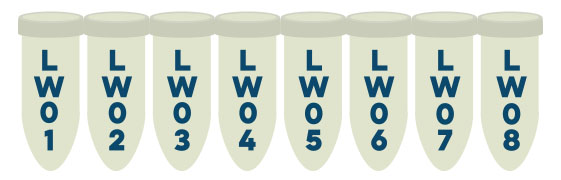
Label your tube on the SIDE with the tube ID generated from your online order form. The tube ID is made up of your initials and the tube number. See figure below (If GENEWIZ was submitting samples, the tube ID would be GW01-GW08-as labeled below). If Jane Doe was submitting samples, the tube ID would be JD01 – JD08.
If you are submitting primers, please label the primer in a way that we can identify them based on the order form.
Can I use 8 strip tubes if I am submitting less than 8 samples?
Yes, you can just cut off the unused tubes and use them for your next submission, or send the entire 8-strip with labels on just the tubes containing your samples.
What type of 96-well plate should I use to submit my samples in bulk format?
Feel free to use any brand of PCR plates and caps. Be sure to load your plates in the column or vertical direction. Here are a few suggestions of plate/cap combinations that work well for a tight seal:
Nunc (through Fisher): 96-Well PCR Plates- 12-565-536, 12-566-133, or 12-566-134, Caps- 12-565-810 or 12-575-123
Nunc (through VWR): 96-Well PCR Plates- 73520-694, 83009-280, or 73520-696, Caps – 73521-364 or 73521-066
USA scientific- Plates- 1402-9400, 1402-9600, 1402-9700 with caps- 1400-0800 or 1400-3800
ABI- Plates 4306737, Caps 4323032
What do I need to provide for you to perform PCR cleanup on my samples?
Submit your unpurified PCR products with your primer(s) in separate, well-labeled tubes. Also include a gel image and the amount loaded on the gel. Be sure to select “Custom” as your service type and choose “PCR clean up” from the Special Request column when submitting your order. We will perform the clean-up and then optimize the sequencing reaction based on your gel image.
How do I send my samples to GENEWIZ?
- If you plan to use a GENEWIZ dropbox or want to learn more about our dropbox network, visit our dropbox FAQ.
- If you do not have access to a dropbox, you can ship your samples to our laboratory. The shipping address of the lab that processes your samples can be found on your order receipt.
Do I need to send my Sanger samples on ice/dry ice?
For purified plasmid and PCR samples, you can submit your samples and primers at room temperature, and the material should be stable for multiple days. For shipping bacterial colonies, agars do not typically need to be sent on ice, but samples sent in liquid culture or as glycerol stocks may require extra measures to ensure samples arrive intact. If you have questions, please contact DNAseq@azenta.com.
Are there any reagents, chemicals, or other products that are incompatible with your Sanger process?
Contaminants (salts, EDTA, alcohol, protein, RNA, detergents, cesium and phenol) carried over from sample preparation can lead to poor Sanger sequencing results.
Master mixes with loading dyes can be compatible with Sanger sequencing. However, we encourage you to consult the manufacturer’s documentation to see if the dyes impact downstream applications. If in doubt, we suggest a small trial order (2-4 samples) to ensure compatibility.
Can GENEWIZ store primers for me?
Please place an “Oligo Retained for Sanger” order; in turn, we will store your primer for up to 1 year or until the primer is depleted. We are not able to accommodate the storage of primers submitted by customers as we cannot confirm the concentration, quality and sequence of the primers.
Managing Your Sanger Order
What is the status of my Sanger order?
There is a column that lists the order status in the ‘MY ORDERS’ section of your account.
What do the different order statuses mean?
- Waiting for sample – the order has been created and GENEWIZ is awaiting receipt of the starting material
- Received – the order has arrived at our laboratory
- Processing – our laboratory staff have initiated processing and the order is actively being prepared for sequencing, sequenced, or pending data delivery
- Completed – data has been delivered and the order is available to be invoiced, based on the work completed
My order has been in ‘Received’ or ‘Processing’ status for longer than I expected. What should I do?
It is possible the lab may have run into issues that could lead to delays in processing (e.g. sample discrepancy, insufficient volume, etc.). Please check the email address associated with your GENEWIZ account for updates. If there are no updates, please contact DNAseq@azenta.com.
How do I cancel or discard my Sanger sequencing order?
- If your order is in ‘Waiting for Sample’ or ‘Submitted’ status, you can select the order on your home page and click ‘Delete’. GENEWIZ only charges for samples we process and if your samples have not been received by our lab, you can cancel the request and no charges will be applied.
- If you never submitted your samples to GENEWIZ, there is no other action required!
- If you shipped your samples or placed them in the dropbox, please contact DNAseq@azenta.com and let us know that you intentionally canceled the sequencing request.
- If you need to cancel your sequencing request and your order is NOT in ‘Waiting for Sample’ or ‘Submitted’ status, please reach out to DNAseq@azenta.com; a cancelation fee may apply if your samples have reached the ‘Processing’ status.
How long do you keep my samples?
View our Sample Storage Policy for more details.
- Plasmids and PCR (purified and unpurified) samples are stored for 5 business days (1 calendar week) from date of receipt. Primers received along with the plasmids and PCR samples are stored
- Bacterial colonies, glycerol stocks, and phage are stored for 10 business days (2 calendar weeks) from date of receipt. Primers received along with these samples are stored for the same duration.
- Oligo Retain for Sanger (oligos synthesized by GENEWIZ) are stored for 1 year from date of synthesis.
When will my order be billed and can I have the invoice for my order?
GENEWIZ only charges for Sanger reactions that are processed and orders are billed upon completion.
Orders paid with a credit card are typically charged within 24 hours of order completion. Orders paid with a PO are typically invoiced in accordance with your institution’s billing internal (e.g. weekly or monthly).
To access your invoice, we have a step-by-step guide here that you can follow.
DNA Sequencing Results
When will I receive my DNA sequencing results?
If you requested Same Day service, you will have your results the same day your samples arrive at GENEWIZ (when samples are received by 10 AM). If you requested Standard Service, you will have your results by noon the next business day following sample receipt at GENEWIZ. Note that customers using our San Diego, Boston, North Carolina, San Francisco and Seattle Labs enjoy faster local service. Please contact us for details and eligibility. You will receive an e-mail notification when your results are available.
What software can I use to view my results?
From the “Recent Results” section of your account, you have access to the page where you can download your data (both the .seq and .ab1 files). The .seq file is a text file and can be opened with any program that can view text files (Wordpad, Notepad, etc.) If you are having difficulty opening these files, you can change the file extension from .seq to .txt as a last resort to view it.
The .ab1 file is your chromatogram, and requires chromatogram viewing software to view these files. Please visit Tools for viewing Sanger Sequencing data for a number of free software programs that are available for viewing trace or chromatogram files.
How long do my results stay in the online system?
We strongly recommend that you download all of your results and back them up on your laboratory computer. Our current policy is to store your results for 2 years. After 2 years, the data will no longer be available for retrieval. This policy is subject to change at any time, but changes, if any, will be clearly communicated.
How do I read or interpret my Sanger sequencing results?
We encourage you to review our Sanger results guide. If you still have questions or concerns after reviewing the guide, please feel free to contact DNAseq@azenta.com and our Technical Support team is happy to assist you further.
Troubleshooting
What should I do if my sequencing results failed?
If you are experiencing any difficulties with your order we are always happy to assist your troubleshooting efforts; PhD-level troubleshooting assistance is free of charge. Please call GENEWIZ Technical Support or email us at dnaseq@azenta.com for assistance.
What does it mean when I have a poly A/T region resulting in poor quality sequence?
When the polymerase encounters a homopolymeric region such as poly A or poly T in the sequence, it often results in subsequent non-specific or poor quality sequence due to slippage of the enzyme. When this happens, we generally recommend sequencing from the opposite direction to obtain the missing sequence data.
I have a very long primer and am getting bad results. Why?
A longer primer has a higher Tm, which will not anneal to your DNA template properly during the sequencing reaction and would generate unsatisfying results. We recommend that you use our Universal Primers or design your own primers that are about 18-24 bases in length with a Tm of 56-60 degrees.
PCR primers were used for sequencing. Why didn’t they work? Could the problem be a degraded primer?
While degraded primer could be the culprit, another possibility is that your PCR primers are good for PCR reactions but not suitable for sequencing reactions. For sequencing primers, we recommend that they are about 18-24 bases in length with a Tm of 56-60 degrees. Longer PCR primers usually do not generate good results for sequencing reactions. Also, not all PCR primers work well as sequencing primers. If your PCR primer is not generating good sequencing results, we recommend that you design a nested primer to use as your sequencing primer.
How do I place a repeat request?
For most Sanger orders, you receive a set number of free repeats that can be placed on any sample that fails our quality control. From your results page, in the ‘Repeat’ column, you can select the ‘Free Repeat’ option.
You can also request modified repeats (e.g. dilution or GC-rich/difficult template protocol). Additional charges may apply.
Please note that free repeats are processed as straight repeats using the original sample material and primer and must be requested within our sample storage policy.
Why is the repeat request dropdown greyed out or why don’t I see the option for free repeat?
Based on our sample storage policy, repeat requests for samples that failed our QC can be made directly on the website for up to 4 business days after the initial processing. If you have a repeat request on the 5th business day after processing, please contact DNAseq@azenta.com as soon as possible for eligibility.
If you don’t see the option for a free repeat, it is likely the sample either passed our QC or the sample was processed 5+ business days ago and the sample is not available for free repeat. If neither are applicable, please contact DNAseq@azenta.com.
What do the different analysis results mean and how can I troubleshoot them?
If you click the ‘Analysis Result’ link on your results page, a pdf will open and provide tips and suggestions for the respective analysis result.
My premixed or predefined orders routinely show smearing or spectral pull-up. How can I avoid this?
When we see smearing or spectral pull-up in samples, these reactions are reloaded (the existing Sanger product is diluted and re-run).
If your samples are smearing or have spectral pull-up regularly and you are submitting within the submission guidelines, this typically means you have high quality DNA and/or a highly efficient sequencing primer, resulting in an excess of Sanger product. To avoid these results, you could reduce the amount of DNA you submit by ~10-20% and see if this helps to reduce the frequency of the smearing/spectral pull-up.
Note: we would not typically expect smearing or spectral pull-up in Custom orders as our lab will measure the concentrations and apply an appropriate dilution.
Regulatory DNA Sequencing Services
Are you GLP (Good Laboratory Practice) compliant?
The GENEWIZ Quality System is developed in accordance with applicable FDA GLP regulations described in Title 21, Part 58 of the Code of Federal Regulations and EPA GLP regulations described in Title 40, Part 160 of the Code of Federal Regulations. We offer GLP services including GLP DNA sequencing and GLP level molecular biology projects. For more details, please contact us at 877-436-3949 or regulatory@azenta.com.
Sanger-EZ FAQs
What is Sanger-EZ?
Sanger-EZ is a prepaid, Pre-Mixed service that combines the convenience and sample security of barcoded tubes and the quality of automated Sanger sequencing. With Sanger-EZ, you’ll enjoy the highest level of ease as subsequent Sanger reactions do not require online orders. After you receive your Sanger-EZ tubes from GENEWIZ, simply fill them with your DNA + Primer and send them back to us for sequencing! Our system will autogenerate an order in your account referencing the barcode numbers on the tubes as DNA names.
How will I receive my sequencing data?
When our lab receives your Sanger-EZ samples, our system will create a new order (30-xxxxxxxxx) in your GENEWIZ account and will be visible in the “My Orders” section. Results can be viewed here when ready. You will receive an email with a link to view the results when available. IMPORTANT: The barcode number of the tube will be used as the DNA/Sample Name when viewing the results. Please make sure to record this number prior to submission.
How can I order Sanger-EZ?
The Sanger-EZ service is available for purchase within your GENEWIZ customer account. Select the Sanger Sequencing tab on the left and then the bubble labeled “Sanger-EZ”. Sanger-EZ tubes are sold in racks of 96 tubes.
What Sanger sequencing service type can be used with Sanger-EZ?
Sanger-EZ utilizes our Pre-Mixed service type. Please submit your DNA + primer in the provided Sanger-EZ tube, according to our Sample Submission Guidelines for our Pre-Mixed service.
How do I submit my Sanger-EZ tubes for sequencing?
- Prepare your reactions according to our Sample Submission Guidelines for our Pre-Mixed service.
- Sanger-EZ tubes can be submitted to either a GENEWIZ dropbox or shipped to a GENEWIZ facility. IMPORTANT: if submitting to a “By-Request” GENEWIZ dropbox, a pickup request must be placed to ensure sample pickup by our courier. Pick-up requests are made within your GENEWIZ account under “DROP-OFF AND DELIVERY BOXES”.
- Ensure to note the barcode number for each reaction. This number will act as the sample name to view results after processing.
When will I receive my Sanger-EZ results?
Sanger-EZ is a standard service, you will have your results by noon the next business day following sample receipt at GENEWIZ. Note that customers using our San Diego, Boston, North Carolina, San Francisco, Seattle, and Maryland Labs enjoy faster local service. We always send an e-mail notification when your results are available. Feel free to log in to your account at any time to check the status of your order.
Can I request repeat sequencing?
Unfortunately, due to the automated workflow of Sanger-EZ, repeats are not available. Please call GENEWIZ Technical Support or email us at dnaseq@azenta.com for assistance.
Can I share my Sanger-EZ tubes with my colleagues?
Yes, you can share your Sanger-EZ tubes with colleagues within your institution! This can be done from the “My Sanger-EZ” bubble or tab.
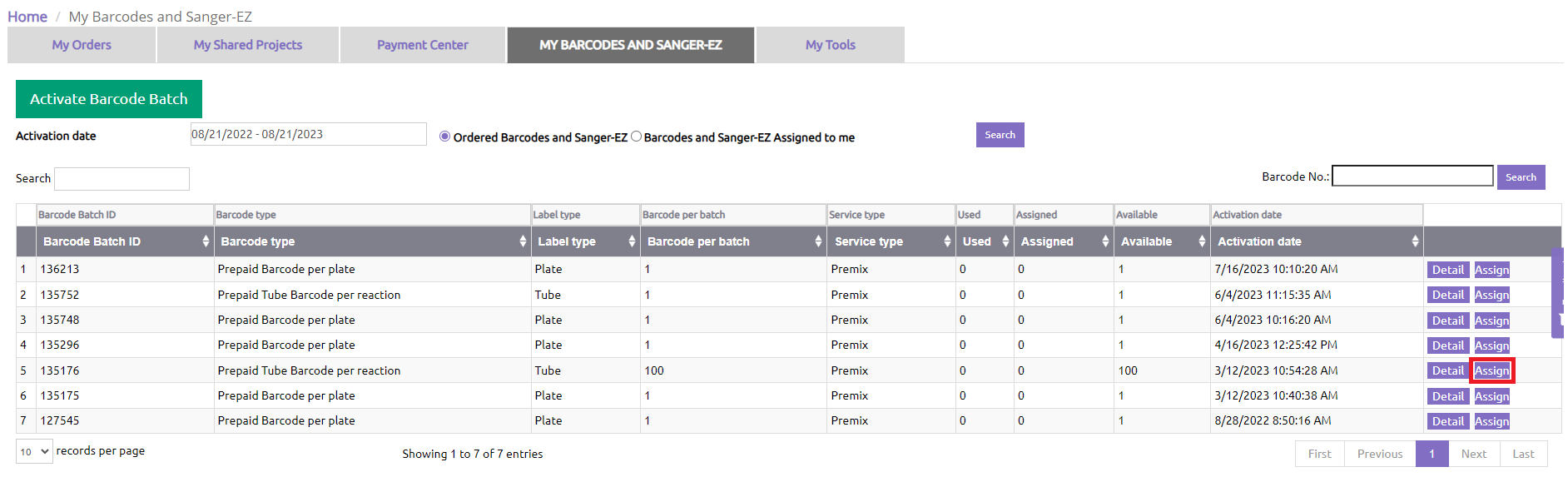
Find the Sanger-EZ batch you would like to share and click “Assign”.
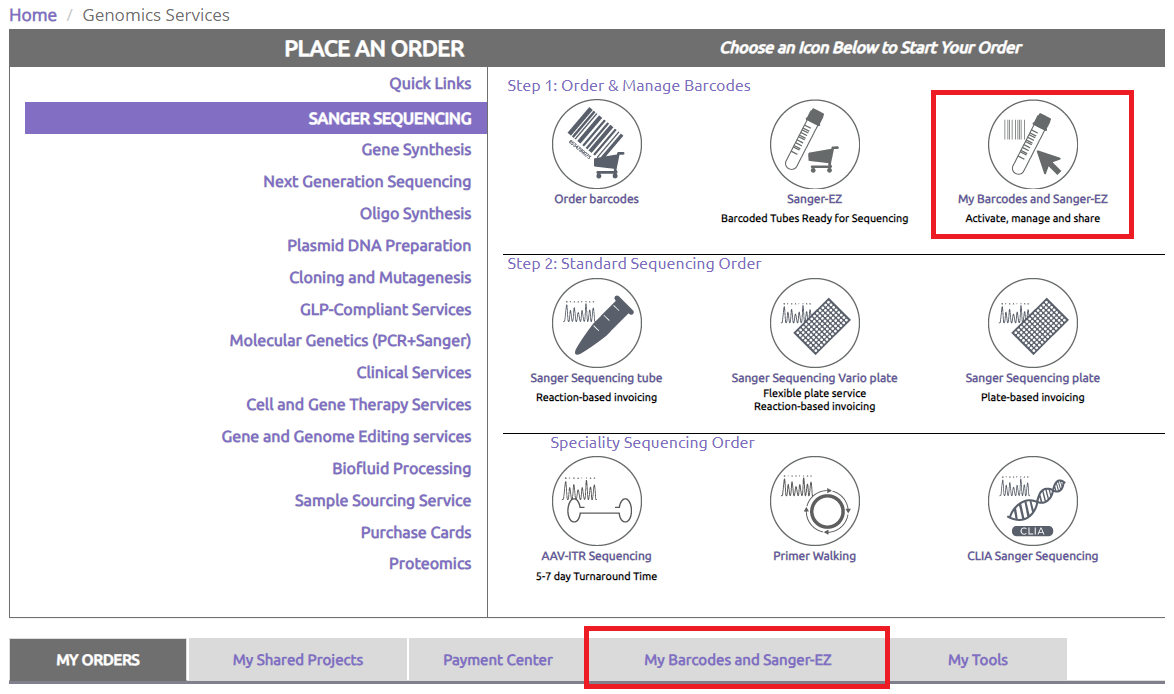
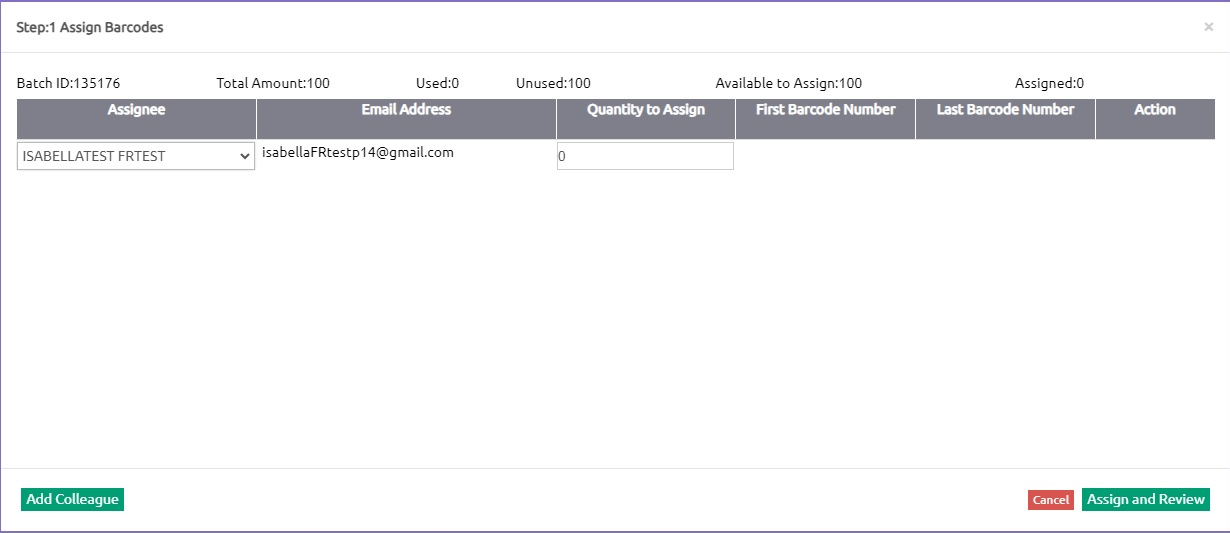
Select 1 or more colleagues and follow instructions to share Sanger-EZ tubes.
Low Concentration Plasmid
What types of samples can be submitted for the Low Concentration Plasmid service?
Only plasmids can be submitted through this service line. It may be useful for samples where the concentration does not meet our submission guidelines or has low copy number plasmids. It can also be useful for samples that have genomic DNA contamination.
Do I need to submit a primer?
Yes, we will require a primer submitted in a separate tube from the plasmid sample. You are welcome to use a primer stored at GENEWIZ. If submitting your own primer, we will require 5ul of 5uM primer per sample.
What can I expect from the results?
The low-concentration protocol should provide you equivalent results to our standard protocol for samples that require template amplification, with a read length of between 500-1000bp. You can still apply our alternative sequencing protocols through the order form for difficult templates.