

Whole Plasmid Sequencing
Whole plasmid sequencing delivers complete plasmid validation in a single run without primers or sequence gaps. Simply submit a bacterial colony or purified plasmid DNA for fast, accurate results.
GENEWIZ returns fully assembled and annotated plasmid sequences, enabling you to verify construct integrity, identify sequence variants, and advance your research with confidence.
Whole Plasmid Sequencing Services
-
Plasmid-EZ
Plasmid-EZ is our end-to-end solution for cost-effective, rapid, and high-throughput sequencing of entire plasmids.
-
Direct Colony to Whole Plasmid Sequencing
Simplify your research workflow and enhance your productivity with our advanced whole plasmid sequencing service (Plasmid-EZ), now accepting bacterial samples as starting material.
Amplicon Sequencing Services
-
PCR-EZ
PCR-EZ product sequencing is a long-read NGS-based PCR sequencing service that utilizes Oxford Nanopore Technologies® (ONT).
-
PCR-EZ Max
PCR-EZ Max is an advanced long-read sequencing service utilizing ONT to analyze heterogeneous PCR products.
-
Amplicon-EZ
Amplicon-EZ is a streamlined version of next generation sequencing to analyze heterogeneous PCR products.
Plasmid Construction Workflow
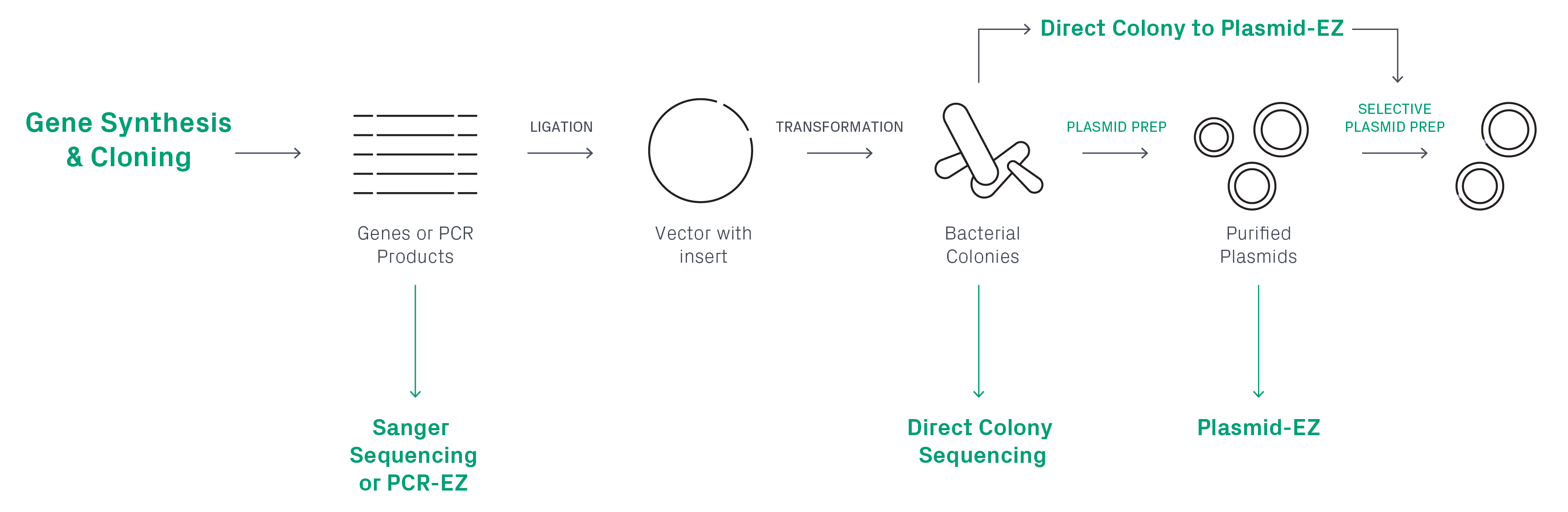
Scale Your Sequencing with Confidence
From quick checks to full-length validation, choose the right sequencing solution for every stage of your workflow.
-
<1 kb
Sanger Sequencing
Fast, accurate, and cost-effective for targeted verification and variant detection, perfect for small regions and routine checks.
-
<25 kb
Plasmid EZ & Colony EZ
Go further with full-length plasmid sequencing. Confirm complex constructs and identify variants quickly and reliably, with rapid turnaround times.
-
<25 kb
PCR-EZ
Unlock long-read insights from clonal PCR products without primers. Get comprehensive verification and detect variants across larger constructs, all within just one business day.
-
<25 kb
PCR-EZ Max
Get more with enhanced read depth to confidently analyze mixed populations and detect low-frequency variants.
-
Multiple scales
One Workflow, Multiple Scales
As your read length needs grow, so do your capabilities, without sacrificing speed or accuracy.
GENEWIZ Sequencing Service Comparison
| GENEWIZ Service | Starting Material | Technology | Primer | Cost | Read Length | Reads / Read Depth | Best For |
|---|---|---|---|---|---|---|---|
Colony-EZ |
Bacterial colony Liquid culture Colonies in water |
Oxford Nanopore® Long-read NGS | None | $$ | <25 kb | <1,000 |
|
Plasmid-EZ |
Plasmid | Oxford Nanopore® Long-read NGS | None | $$ | <25 kb | <1,000 |
|
PCR-EZ Max |
Purified or unpurified PCR product | Oxford Nanopore® Long-read NGS | None | $$ | <25 kb | Up to <5,000* |
|
PCR-EZ |
Purified or unpurified PCR product | Oxford Nanopore® Long-read NGS | None | $$ | <25 kb | <1,000 |
|
Amplicon-EZ |
Purified PCR product | Illumina® Short-read NGS | None | $$ | 150–500 bp | <50,000 |
|
Sanger Sequencing |
Purified or unpurified PCR product | Sanger | Per reaction | $ | <1,000 bp | 1–4 |
|
*Read count depends on amplicon number and plasmid size. Expect up to 5,000 reads for amplicons under 6 kb.
Understanding Whole Plasmid Sequencing
Whole plasmid sequencing is end-to-end sequencing of the entire plasmid without primers. It utilizes Nanopore technology to generate long-read sequence data.
Yes. Colonies can be submitted on agar, as liquid culture, or as colonies in water for processing.
The starting material determines the right service. For purified plasmids, use Plasmid-EZ. For colonies, use Colony-EZ.
No. Primers are not required for whole plasmid sequencing with Plasmid-EZ or Colony-EZ.
Sequencing accuracy is very high when sufficient read count is attained for the assembled contig.
Absolutely. Whether you have a single amplicon, multiple amplicons, or require deeper sequencing coverage, we offer a solution tailored to your project.
PCR-EZ provides end-to-end sequencing coverage for amplicons up to 25 kb, making it ideal for long-fragment verification and characterization.
Amplicon-EZ is designed for amplicons up to 500 bp when high-confidence sequence data and in-depth coverage are required.
Sanger Sequencing offers a fast, reliable option for targeted sequencing of fragments under 1 kb using sequencing primers.
PCR-EZ MAX, our newest long-read sequencing solution, is optimized for mixed amplicon samples and projects that demand higher sequencing coverage, delivering greater flexibility and enhanced data quality.
The GENEWIZ Difference
-
Rapid Turnaround Times
Same-day results in designated areas or as fast as 8:00 AM next day
-
Easily Submit Samples
At one of our 1,800+ conveniently located dropboxes
-
Interactive Data Report
Provides an easy way to understand sequencing results
-
High-throughput, plasmid-to-data solution for rapid and interactive construct validation directly from bacteria
-
Same price across all plasmids, regardless of size and complexity
-
Low-cost, unbiased coverage for use in selection of complete, valid plasmid candidates
-
Flexible sample types accepted – bacterial colonies, liquid culture, and glycerol stock
*Results available by 8 AM the next morning for customers located near one of our 6 overnight sequencing labs. For customers who ship samples to our New Jersey facility, results will be available by the end of the day that the samples are received.
Technical Resources
-

Blog | From Colonies to Confirmed Plasmids: A Workflow Many of Us Know Too Well
Discusses challenges researchers face during plasmid cloning and validation workflows, particularly after bacterial colony screening following cloning experiments. It highlights how whole plasmid sequencing using Nanopore technology can provide faster, more comprehensive construct confirmation to help accelerate downstream research.
-

Webinar | From Base Pairs to Breakthroughs: Understanding Sanger and Oxford Nanopore Sequencing
While Sanger sequencing remains the gold standard for accurate DNA sequencing, advancements in sequencing technology, such as Oxford Nanopore Technology (ONT), have provided a cost-effective, long-read alternative for analysis.
-
Tech Note | Optimizing Plasmid Preparation to Increase Yield and Reduce Endotoxins
Plasmid DNA (pDNA) is vital for a range of biopharmaceutical and biotechnological applications but maximizing yield while minimizing endotoxins can be challenging. This tech note explores strategies to optimize bacterial growth conditions, enhance lysis, and refine purification protocols to boost pDNA yield and purity, ensuring consistent, high-quality results.