

Gene Synthesis & Cloning/Mutagenesis FAQs
The Most Commonly Asked Questions
What are the differences between your gene synthesis service options?
| Service | Service Offering | Production Turnaround Time |
|---|---|---|
| Fast Fragments & FragmentGENE | Double-stranded DNA fragment synthesis for rapid cloning and screening | Starting from 24 hours |
| Gene Synthesis 2.0 | Gene synthesis with cloning into plasmids,100% sequence accuracy | Starting from 5 business days |
| AAV Plasmid Synthesis | AAV sequence synthesis and cloning with ITR verification for construct integrity | Starting from 11 business days |
| ssDNA Synthesis | Synthesis of single-stranded DNA fragments up to 8 kb | Starting from 10 business days |
| Oligo Pool + HT Cloning | Parallel synthesis and cloning of thousands of sequences with >95% efficiency | Starting from 4 weeks |
| DNA Mutant Library | Custom mutant library construction for protein engineering and functional studies | Starting from 11 business days |
Where can I get general pricing before submitting a quote request?
To access pricing information for your institution, please contact your sales representative.
How do I request a quote for gene synthesis services?
Log in to your GENEWIZ account located on the top right corner, select the service of interest, and enter your sequence to receive an estimated price.
For services such as AAV Plasmid Synthesis, DNA Mutant Library, ssDNA Synthesis, and Oligo Pool + High-Throughput Cloning, a quote is required before ordering. Please complete the online request form and submit your inquiry. Our team will review your project and provide a quote.
What vector do you clone into?
We can clone your gene into any vector of your choice, including vectors from the GENEWIZ vector library or your own custom vector. Custom vector onboarding is free of charge.
How do I submit the starting material required for cloning?
Please provide a 5 µg aliquot of circularized plasmid (minimum concentration 20 ng/µL). Samples can be shipped at room temperature to the address below or submitted via any available GENEWIZ dropbox.
To ensure proper identification, include the first page of your order receipt or quotation in the package. If unavailable, please include the project tracking number.
Shipping Address:
Azenta
Attn: Project Management
115 Corporate Boulevard
South Plainfield, NJ 07080
USA
Can you store my vector?
We store any starting material provided and final constructs generated at our facility for up to two years to be used for future orders. For more information, please review our Sample Storage Policy.
What is the recommended DNA resuspension protocol?
GENEWIZ sample tubes are delivered containing 2–5 µg lyophilized plasmid DNA for gene synthesis orders, or 500 ng–1 µg purified linear dsDNA for FragmentGENE orders. For resuspension, we recommend the following:
- Spin the tube briefly to ensure that the contents are at the bottom of the tube.
-
Resuspend the sample in a volume appropriate for your needs.
- For example, use 20–50 µL to achieve approximately 0.25 to 0.1 µg/µL with sterile high-purity water.
- The resuspension solution depends on downstream applications; TE may interfere with various enzyme manipulations.
- Vortex briefly, let the DNA tube sit for 2–10 minutes on ice, then vortex again.
Ordering
How do I request a bulk gene synthesis order?
For large orders (e.g., >500 genes), we recommend downloading the Excel ordering template and completing the required information.
Once completed, please email your request to GS@azenta.com, and our Project Management team will assist you with processing the order.
How do I confirm a gene synthesis quote?
To confirm a quote, log in to your online GENEWIZ account. All submitted inquiries and orders will be visible at the bottom of the page under “My Orders”.
Select the “Review Quote” button next to the related project tracking number (30-xxxxxxxxx). After this is done, an “Add to Cart” button will appear at the bottom of the screen. Once this is selected, you will be redirected to the ordering page where you will be able to review our Terms and Conditions and enter the payment information for this order. After this is done, select the “Confirm” button at the bottom of the screen to place your order.
Who provides support for gene synthesis projects?
Our Project Management Team is happy to help with any questions. Please feel free to contact us from 9:00 AM – 6:00 PM ET via phone 1-908-222-0711 ext. 2, email gs@azenta.com, or live chat.
What is the advantage of using the AAV plasmid synthesis service?
With our AAV plasmid synthesis service, we can synthesize and clone transgene expression cassettes into custom AAV vectors with high efficiencies. All final products will come bundled with mini-scale or large-scale DNA preparation using our new AAV plasmid preparation protocol and AAV-ITR sequence verified AAV plasmids. This service also offers ITR correction if mutations are found after sequence-verification of these regions.
Gene Synthesis 2.0
What are the key benefits of your gene synthesis services?
Fast turnaround, competitive pricing, and industry-leading performance, including:
- >99.9% sequence accuracy
- >99.8% project success rate
- >82% of projects delivered ahead of schedule
All supported by a streamlined online ordering experience and dedicated project management, providing regular updates and expert consultation throughout your project.
How are genes synthesized?
Genes are built from synthesized DNA fragments, assembled into full-length constructs, and cloned into your selected vector, followed by sequence verification.
What gene lengths can you support?
We support a wide range of gene lengths, from short DNA fragments to 150+ kb constructs, with proven success in constructing genes up to 150 kb, delivering high success rates across projects of all sizes.
What cloning methods can you support?
We support a wide range of cloning methods to fit your needs, including RE cloning, Gibson Assembly, Gateway cloning, seamless and recombination-based cloning, as well as de novo construct synthesis.
Can you synthesize sequences with high GC content or repeats?
Yes. We specialize in challenging sequences with a >99.8% project success rate, including high GC content, repeats, and complex elements. Such sequences may require the FLEX service, adjusted timelines and charges.
How do you protect intellectual property?
At GENEWIZ from Azenta, the protection of our customers’ intellectual property is a top priority. Proprietary information is always under client ownership, and we place the utmost importance on confidentiality and privacy. Comprehensive protective measures enable us to earn and maintain the trust and confidence of all customers, collaborators, and partners. View our Confidentiality Policy to learn more.
What are the differences between SPRINT, FLEX, and FLEX+?
Our packages are designed to fit your needs:
- SPRINT: Fast, cost-effective option for simple constructs
- FLEX: Supports any sequence and vector, including complex designs
- FLEX+: Expedited FLEX service for faster turnaround
What quality control (QC) is performed?
All gene synthesis projects include Sanger sequencing of the insert to ensure 100% sequence accuracy.
FLEX and FLEX+ packages also include restriction enzyme analysis to verify construct integrity.
What deliverables will I receive?
Deliverables include 2–5 µg of plasmid DNA, a Certificate of Analysis (CoA) with sample information, sequencing alignment files, sequence files for both the synthesized insert and final construct (if applicable), and a restriction digest gel image (if applicable).
Optional plasmid prep DNA services are available for scale-up, including endotoxin-free and high-supercoiled DNA options.
What vector backbones can I clone into?
Cloning is available into GENEWIZ’s vector library (from cloning to expression vectors) or your own custom vector. Custom vector onboarding is free of charge.
Do you comply with biosecurity and export control regulations?
Yes. All orders undergo biosecurity screening to identify sequences of concern (SOCs) and ensure responsible use. We follow IGSC screening protocols and implement strict biosecurity and export control measures in accordance with U.S. regulations, including the OSTP Framework for Nucleic Acid Synthesis Screening (April 29, 2024).
Recombinant Antibody Production
Do you offer any expression vectors?
Yes, we offer GENEWIZ proprietary vectors optimized for recombinant expression, delivering up to 6× higher yields compared to traditional pcDNA3.4 vectors. You may also provide your own preferred expression vector if desired.
Where can I get the antibody genes?
GENEWIZ offers a one-stop solution from gene synthesis and cloning to plasmid prep, antibody expression, and QC, providing everything you need from sequence to purified antibody.
What antibody formats can you express?
GENEWIZ supports a wide range of antibody formats, including IgG, VHH (nanobodies), scFv, Fc-fusions, bispecific and multispecific antibodies.
What throughput, scale, and expression platforms do you support?
We support high-throughput production of 1,000+ antibodies per batch, with expression scales ranging from 1 mL to 20+ L, using both CHO and HEK expression systems.
What antibody yields can I expect?
Our high-expression platform delivers average small-scale yields of approximately 500 µg/mL in CHO and 350 µg/mL in HEK for standard IgG. Actual yields may vary depending on antibody design and sequence.
What is the purity and endotoxin level of delivered antibodies?
We deliver antibodies with a target purity of >95% and endotoxin levels <1 EU/mg.
What quality control (QC) is performed for purified antibodies?
All projects include A280 quantification and SDS-PAGE (reduced and non-reduced) analysis for purity. Endotoxin testing and SEC-HPLC are standard for scales >30 mL and performed as spot checks for ≤30 mL, with options to add as needed.
What add-ons and downstream analytical services do you offer?
GENEWIZ offers 30+ add-on QC and analytical services, including advanced purification (SEC, IEX, HIC), and downstream analyses such as LC-MS, peptide mapping, purity analysis, and binding assays (ELISA, BLI, SPR). Custom requests are supported.
AAV
What is the required starting material for AAV packaging?
GENEWIZ requires either the sequence of your gene of interest (GOI) or a full-length transfer plasmid to provide AAV particles.
If providing a GOI sequence, we’ll synthesize and clone the gene into your custom vector. For submitting a custom vector, please provide at least 5 µg of starting material normalized to >200 ng/µL.
If you prefer to directly submit the plasmid, please submit 1 mg per 1E13 vg target yield.
What is the packaging capacity for AAVs?
AAV packaging capacity is typically ~4.7 kb (inclusive of the ITRs from ITR-ITR). We can package larger cargo, but this is typically associated with a reduction in titer and transduction efficiency.
How are the viral particles produced?
In vivo grade GENEWIZ ultra-purified AAV particles are produced by simultaneous transfection (triple transfection) of suspension HEK293T cells with RepCap, Helper, and transfer plasmids; the transfer plasmid contains your gene of interest. Virus is then purified by iodixanol density gradient ultracentrifugation, followed by buffer exchange and concentration to the final volume.
In vitro grade AAV particles are produced by the same triple transfection process, but they are purified using only PEG precipitation and centrifugation, and do not undergo iodixanol purification.
How are samples delivered?
Viral particles are delivered on dry ice, suspended in buffer, with a certificate of analysis. Our default delivery format is up to 20 aliquots of viral particles. For any number of aliquots >20, there is an added charge of $5 per aliquot.
What are the recommended storage conditions and shelf life of AAVs?
AAVs are delivered on dry ice and should be stored immediately at –80°C. When stored under these conditions, AAVs can last several years. Multiple freeze-thaw cycles are not recommended.
What QC is included in AAV Packaging?
Viral titer and endotoxin measurement are both part of standard quality control for AAV packaging. The viral titer is determined by qPCR with ITR primers, and endotoxin measurement of <10 EU/mL is determined by an LAL test. As an add-on QC, <1 EU/mL is available.
Can you offer ddPCR?
Yes, we offer dPCR or ddPCR as optional add-on quality control services.
Can you test the percentage of full/empty capsids?
Yes, we offer TEM, which can measure the empty and full capsids, as an optional add-on quality control service. Please note that this does not distinguish between full and partial capsids; if partial capsid determination is necessary, we recommend NGS viral genome analysis.
What is the yield of viral particles?
The production yield varies based on the production scale and viral serotype. As an example, most 1 mL orders for a high-yield serotype are 1E13 vg.
What is the viral titer?
The standard titer is 1E13 GC/mL for ultra-purified virus.
Can you accommodate packaging for AAV libraries?
Yes, we do routinely offer packaging of AAV libraries, specifically for ITR-containing transfer plasmids. Many customers will also characterize the diversity of the virus using our viral sequencing with NGS.
Can you accommodate packaging for AAV capsid libraries?
If you are interested in capsid library packaging, we can take those projects on a case-by-case basis depending on the diversity of the library. Please inquire with our project management team during your consultation.
Do you offer in vitro grade preparation?
Yes, this is offered for volumes of 250 μL and 500 μL at 1E11-1E12 GC/mL.
Lentivirus
What is lentivirus?
Lentivirus, meaning “slow virus,” is a genus of retrovirus. Retroviruses express reverse transcriptase to convert their RNA genome into double-stranded DNA (dsDNA) and integrase to incorporate this viral DNA into the host genome. Due to this permanent DNA integration, the host cell produces more retroviruses as it divides, resulting in long-term expression of the disease.
Lentivirus has long incubation periods between host infection and the onset of disease symptoms, such as human immunodeficiency virus (HIV) in the case of human acquired immune deficiency syndrome (AIDS). In biotechnological applications, recombinant lentiviral vectors are modified for safe handling and used as a gene delivery vector for mammalian cells.
What is the advantage of using lentivirus?
Unlike other retroviruses that only infect dividing cells, lentiviruses infect both dividing and non-dividing (postmitotic) cells. This broad tropism, coupled with stable integration into a host cell genome, allows for diverse in vitro and in vivo applications, including clinical cell therapy and CAR-T cell engineering. Additional advantages of lentivirus include the ability to express large transgenes (up to 9 kb) and low immunogenicity.
How do you produce lentivirus?
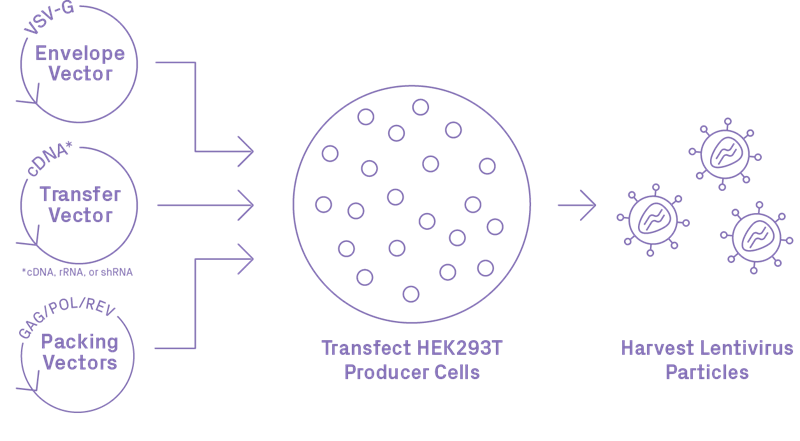
Our team of experts uses HEK293T cells for lentiviral vector production. Following successful transfection with four packaging plasmids, the cell machinery facilitates the assembly and replication of the lentiviral particles during an approximately three-day incubation. Lentivirus particles are then harvested, filtered, purified, concentrated, and aliquoted into small volumes to support downstream transduction applications.
What safety concerns should I be aware of when working with lentivirus?
Recombinant lentiviral vectors are generally considered safe because they are engineered to be replication incompetent, with third-generation systems considered the safest. A third-generation system typically features a chimeric 5′ LTR, a self-inactivating truncated 3′ LTR, elimination of Tat, and a four-plasmid transfection system with a low likelihood of generating replication-competent virus. According to National Institutes of Health (NIH) guidelines, lentiviral particles should be handled as Risk Group 2 (RG2). Our team uses a third-generation packaging system in biosafety level 2 (BSL-2) facilities for all default lentiviral handling.
Can lentivirus vectors be packaged with customized envelope proteins?
Yes. Upon review, our expert team can accommodate custom requests. Our default option uses the envelope glycoprotein of vesicular stomatitis virus (VSV-G protein).
Can pooled libraries be packaged into lentivirus particles?
Yes. Our team has extensive experience packaging various library types, including combinatorial and trimer-controlled libraries. The diversity of the final packaged lentivirus depends on the plasmid material. If you do not already have a library sample, we can generate and validate this for you. Please see our synthetic DNA libraries page for more information.
Do you offer transfer plasmids for cloning?
Yes. We offer various transfer plasmid options for your cloning needs in the context of lentivirus production. If we do not have a vector that suits your requirements, we can synthesize any necessary components to create a transfer plasmid that aligns with your design.
How is quality control (QC) performed on lentivirus particles?
We offer two QC options for the validation of lentiviral particles:
- p24 ELISA (physical titer): This method, offered as our standard QC, uses a sandwich ELISA to detect the presence of p24 protein, a major capsid protein encoded by the Gag gene. The p24 protein level is measured spectrophotometrically against a standard curve. The quantified p24 value is then correlated to the virus particle number. To support downstream applications, we convert lentiviral particles (LP) to TU/mL by dividing by 100 (there are approximately 100–1000 LPs for every active virus). This method is considered a measure of physical titer.
- WPRE qPCR (functional titer): An aliquot of the packaged lentiviral vector is used to transduce HEK293T cells at various dilution levels. After a two-day incubation period, the genomic DNA of the transduced cells is harvested. qPCR amplification of the WPRE element is then performed alongside a calibrated standard curve. The WPRE element is absent in wild-type HEK293T cells but is present within the lentiviral cassette of a transfer plasmid. Because WPRE elements can only be detected in HEK293T cells if transduction is successful, this method is considered a measure of functional titer.
What is the difference between physical and functional titer?
Physical titer approximates the total amount of virus present in the sample by correlating it to the spectrophotometrically quantified p24 in an ELISA assay, regardless of whether the particles contain the gene of interest or can infect cells.
Functional titer is a measure of virus infectivity, quantifying the copy number of the WPRE element, which is detectable only after successful viral DNA integration into the host cell genome. Generally, functional titer is 100–1000-fold lower than physical titer. We report physical titer after accounting for this ratio and express p24 in TU/mL.
What is pseudotyping?
Pseudotyping is the process of incorporating envelope glycoproteins from other viruses to generate lentivirus particles with altered tropism. This is often used to enhance lentivirus infectivity and stability. For example, VSV-G is commonly used for pseudotyping due to its broad tropism.
Codon Optimization
Can you optimize genes?
GENEWIZ from Azenta can deliver codon-optimized genes designed to meet your exact research specifications. These sequences are always available for your review prior to confirming your order and are typically included in the project quote.
How does codon optimization enhance gene synthesis projects?
The GENEWIZ codon optimization tool can optimize for multiple critical parameters to stabilize DNA fragments and improve gene expression efficiency. Parameters include, but are not limited to:
- Codon usage bias
- GC content
- mRNA secondary structure
- Custom desired patterns
- Custom undesired patterns
- Repeat sequences (direct repeat, inverted repeat, and dyad repeat)
- Restriction enzyme recognition sites (deletion or insertion)
Please note that GENEWIZ from Azenta cannot guarantee final protein expression.
Can you optimize my sequence for more than one expression system?
Yes, we offer dual optimization for any two requested expression systems. Additional requirements can also be reviewed by the project team. Please note that any dual-system optimization represents a compromise, and a sequence specifically optimized for a given system may outperform the compromise sequence.
To add this to your order, include the request in the Order Comments
section of your gene synthesis inquiry or email the Project Management Team at gs@azenta.com.
Can I codon optimize a sequence without submitting a quote request?
Yes, the GENEWIZ codon optimization tool is available in the My Tools
section of your online account and can be used at any time.

Cloning and Mutagenesis
My vector is a commonly used expression vector. Do you have it in stock?
We currently only provide our in-house pUC-GW-Kan/Amp vectors for cloning. If you would prefer cloning into a different vector, an aliquot of your custom vector will need to be provided upon confirmation of your order.
If I do not have the required amount of material for my project, what are my alternatives?
GENEWIZ from Azenta can provide transformation and mini-scale plasmid preparation services to create the required template amount for your project. This can be requested as a separate DNA preparation order or bundled with your gene synthesis project. If the latter option is suitable, please add an order comment when submitting your gene synthesis inquiry.
I do not have a custom vector for my project; can you purchase it for me?
GENEWIZ from Azenta currently only offers cloning vectors based on the pUC-GW-Kan/Amp backbone. We are unable to purchase proprietary vectors on your behalf.
If I cannot provide the starting material at the time of order confirmation, will the gene synthesis steps still be initiated?
Yes, the Project Management Team starts gene synthesis at the time of order confirmation.
Can you clone into my vector using Gibson assembly®?
We currently offer an in-house recombinational cloning method that is similar to Gibson assembly. This method can be requested within the order comments of the inquiry form.
What is the difference between subcloning and PCR cloning?
Both services offer cloning of an insert from an existing template plasmid into a different destination plasmid. For our subcloning service, the insert to be cloned is already flanked by the restriction sites to be used for cloning. This service is intended for simple restriction/ligation.
The PCR cloning service is used when an additional PCR step is required prior to cloning. For example, this may be necessary to add the correct restriction sites. Both options can be requested via the same Subcloning
form, and the Project Management Team will internally determine the best strategy upon receipt of your inquiry.
Are there any discounts available for these services?
For information regarding ongoing promotional discounts, please contact your sales representative.
What is the difference between site-directed mutagenesis, insert PCR-based mutagenesis, and TurboMUTANT?
The table below compares the main mutagenesis service options.
| Feature | Site-Directed Mutagenesis | Insert PCR-Based Mutagenesis | TurboMUTANT |
|---|---|---|---|
| Plasmid Size Guidelines | 10 kb or less in size; non-complex | > 10 kb / unstable plasmid | < 8 kb / stable plasmid |
| Turnaround Time | Starts from 8–10 business days | Starts from 10–15 business days | Starts from 5 business days |
Quality and Final Deliverables
How do I know that I am getting the correct sequence?
GENEWIZ conducts sequence verification during the gene synthesis process to ensure your synthesis product is as intended. Final plasmid constructs are clonally isolated and confirmed by Sanger DNA sequence analysis to at least single-strand depth across the synthesized insert. Purified PCR fragments are sequence-verified on both strands, although verification at the fragment ends is limited to single-strand depth.
Subassemblies and intermediate products may be cloned and verified to contain the correct sequence, as needed. DNA sequence re-verification after scale-up DNA preparation is available as an added option to your gene synthesis order.
Upon completion of your synthetic gene, GENEWIZ delivers an electronic data package in parallel with your construct. The data package includes the original sequencing data files from construct verification to facilitate your independent review.
How do you deliver synthetic genes?
Deliverables include 2–5 µg of plasmid DNA, a Certificate of Analysis (CoA) with sample information, sequencing alignment files, sequence files for both the synthesized insert and final construct (if applicable), and a restriction digest gel image (if applicable).
Optional plasmid prep DNA services are available for scale-up, including endotoxin-free and high-supercoiled DNA options
What controls are used for each step completed in my project?
All reagents, materials used, and equipment are kept under strict quality controls by the lab. The Project Management Team may decide to implement additional controls if an uncommon failure rate is observed.
My project is under mutation correction. What does that mean?
Mutations can be found at multiple stages of a project. For example, a synthesized primer may contain an incorrect base. Mutation correction may delay delivery by 1–4 business days, depending on the situation.
Can I add a construct to my already confirmed project?
The GENEWIZ Project Management Team is happy to address additional project requests through a new quotation request that references the current open project. Where possible, any discounts applied to the current project will be incorporated into the new quotation.
Please note that you must confirm the new project within the ongoing project timeline in order to take advantage of these discounts.
Do you sequence verify all gene synthesis products?
Yes, unless otherwise specified in the quotation due to extreme complexity. Single-strand sequence verification across the entire insert occurs for every synthesis product.
If the sequence-verified synthesis product is associated with a large-scale preparation, the product from the large-scale plasmid preparation is sequenced across junctions. Additional sequence verification on the second strand, or after large-scale plasmid preparation, is available if requested (additional charges apply).
What do you guarantee in cases where the construct cannot be sequence-verified or delivered? If the project cannot be completed, what am I expected to pay?
Some extremely complex sequences are expected to be unverifiable using current Sanger sequencing techniques and are noted in the quote. In the very rare event that the Project Management Team is not able to deliver the intended material, there will be no charges for your project (unless otherwise specified in the quotation due to extreme complexity).