

GENEWIZ Posters
-
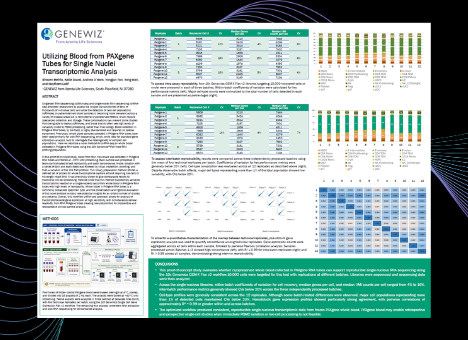
Utilizing Blood from PAXgene Tubes for Single Nuclei Transcriptomic Analysis
Explore how blood collected in PAXgene tubes can support reproducible single-nucleus RNA sequencing with the 10x Flex workflow. This proof-of-concept study demonstrates consistent cell recovery, gene expression, and cell-type identification across replicates, highlighting the potential of PAXgene workflows for retrospective and prospective research.
-
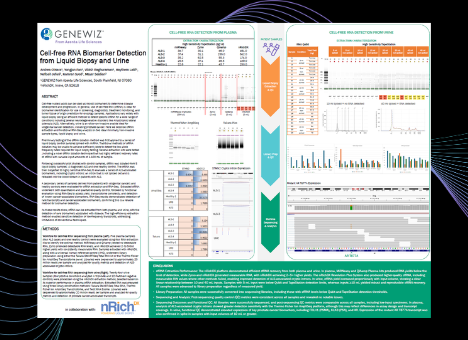
Cell-Free RNA Biomarker Detection from Liquid Biopsy and Urine
Cell-free RNA (cfRNA) from plasma and urine offers a minimally invasive approach for disease biomarker detection and monitoring. Results demonstrate that cfRNA can be successfully extracted and sequenced from both sample types, enabling sensitive detection of disease-associated transcripts, including ALS-related biomarkers and prostate cancer markers.
-
A Novel AI/Ml Approach to Codon Optimization for Enhanced Antibody Expression
This poster highlights an AI/ML-driven codon optimization approach developed by GENEWIZ to improve recombinant antibody expression across multiple protein constructs and host systems. By leveraging large-scale genomic and protein expression data, the platform demonstrated enhanced expression performance and broader applicability compared to traditional codon optimization methods, enabling more reliable and efficient antibody production.
-
Leveraging High-Throughput Platforms for the Discovery of Bispecific Antibodies
This poster highlights GENEWIZ’s high-throughput, machine learning-enabled platform for the discovery, optimization, and production of bispecific antibodies, integrating antibody screening, recombinant production, and purification into a streamlined workflow. The platform demonstrated efficient expression optimization, high-purity production, and scalable manufacturing of complex bispecific formats, accelerating therapeutic antibody discovery for oncology and other targeted applications.
-
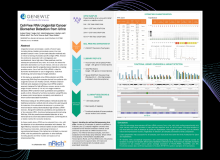
Cell-Free RNA Urogenital Cancer Biomarker Detection from Urine
This work highlights a noninvasive method for detecting urogenital cancer biomarkers using cell-free RNA from urine. A novel nRichDX extraction approach enabled efficient RNA recovery and reliable sequencing across a wide range of sample volumes, supporting sensitive detection of key prostate cancer markers and rare transcripts.
-
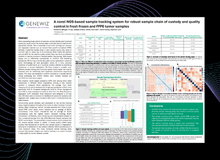
A Novel NGS-based Sample Tracking System for Robust Sample Chain of Custody and Quality Control in Fresh-Frozen and FFPE Tumor Samples
Here we describe a robust, cost-effective sample tracking assay that allows functional quality control as well as sample identity tracking. The panel included varied SNPs across chromosomes with minor allele frequencies that varied between different ethnic groups. With consistently high accuracy and precision for both blood and tumor samples, this assay allows for easy identification of swapped samples, leading to an overall increase in data quality for cancer research studies.
-
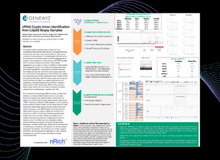
cfRNA Cryptic Intron Identification from Liquid Biopsy Samples
cfRNA can be utilized to detect cryptic introns: an intron that is not spliced out and is released into the bloodstream in patients with amyotrophic lateral sclerosis (ALS). Here we describe liquid biopsy cfRNA extraction and RNA-Seq analysis on a series of ALS-affected and control samples. The results show that cfRNA can be extracted from a limited amount of plasma, with detection of rare biomarkers associated with disease.
-

Cohort-based Integrated Multiomics from Single Sample Blood Draws Provides Comprehensive Holistic Phenotypic Insights
Discover how complex multiomics information can be analyzed from a single sample, including transcriptomics, proteomics, and metabolomics. This integrative approach reduces the need for repeated patient collections and lowers biostorage requirements, making it a more patient-friendly and cost-effective solution to help drive greater insights in human health applications.
-

Effective Quality Control is Crucial Throughout mRNA Product Development
Explore an end-to-end workflow for codon-optimized, high-quality gene synthesis and in vitro transcription, enabling rapid and efficient production of functional custom mRNA. This includes robust quality control by Sanger and/or whole plasmid sequencing, and verification with next-generation sequencing to determine the proportion and full sequence identity of each mRNA, including polyA tail length.
-

Exploring the Role of Inverted Terminal Repeats in AAV Vector Performance for CNS Gene Therapy
In this study, we evaluated the impact of five common ITR mutations, which exhibited varying degrees of integrity and insert length. The results showed that recombinant AAV genomes with partial or more significant deletion of the 5′-ITR had significantly reduced titers compared to wild-type, emphasizing the need to carefully consider ITR integrity and transgene size to maximize therapeutic potential.
-
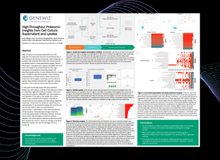
High-Throughput Proteomic Insights from Cell Culture Supernatant and Lysates
In this proof-of-principle study, RNA-Seq and Olink® proteomics were used on a series of samples to incorporate high-plex multiomic analysis in the early drug discovery pipeline. The results show that high-throughput proteomic analysis, together with transcriptional alterations detected by RNA-Seq, supports and confirms multiomic changes, demonstrating its utility for drug screening.
-

Revolutionizing Antibody Therapeutics: Harnessing Machine Learning for Bispecific Antibody Discovery
Machine learning and next-generation sequencing (NGS) are revolutionizing antibody discovery by addressing the inefficiencies of traditional methods. By combining NGS with in vivo and in vitro campaigns, discover how this streamlined approach uncovers up to 50 times more sequence diversity and enables the development of novel tool antibodies and bispecific antibodies.
-

The Long and Short of It: Comparing Next Generation Sequencing Methods for Quality Control in AAV Development
Here we describe dual testing of AAV with Oxford Nanopore® GridION™ and PacBio® Revio™, which yielded comparable results. Using advanced data analysis with the Form Bio™ LAVAA pipeline, we explore how a combined NGS approach is ideal for testing of packaged product throughout the development and manufacturing life cycle.
-

Clinical Validation of a Haplotyped Whole Genome Sequencing Assay Using PacBio HiFi Sequencing
Long reads enable detection of challenging variants and allow for haplotyping, which may be especially critical in rare disease. Here we report the validation of a clinical long-read whole genome sequencing (WGS) assay for the comprehensive genome-wide detection and phasing of SNVs and INDELs. This validated long-read WGS assay overcomes key limitations of short-read technologies, enabling comprehensive genome-wide detection and phasing of all variant classes.
-

Direct Detection and Counting of Trinucleotide Repeat Expansion Using CRISPR-Cas9 and PacBio HiFi Sequencing
Here we describe a novel PCR-free CRISPR-Cas9 approach combined with long-read PacBio® sequencing for characterizing trinucleotide repeat expansions. By overcoming limitations of traditional techniques, this approach paves the way for improved understanding of genotype-phenotype relationships and the molecular basis of neurological and developmental disorders caused by repeat expansions.
-

Harnessing the Power of Multiomics from Fresh and Fixed Patient Sample Characterization
Complex multiomics information can be collected from a single sample, including genomics, transcriptomics, epigenomics, and proteomics, enabling deeper insights into post-treatment response and biomarkers for future discovery. Here we describe different multiomics workflows and how they can be modified to accommodate a variety of input sample types, allowing for flexible sample processing.
-
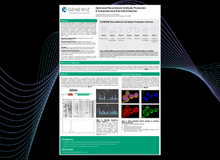
Optimized Recombinant Antibody Production: A Comprehensive End-to-End Solution
Explore a robust, end-to-end service for antibody expression and purification, with optimized expression vectors for expression in both HEK293 and CHO platforms. This streamlined workflow empowers researchers to scale up with confidence and includes rigorous QC to help ensure high-quality antibodies that meet or exceed industry standards.
-

Short- and Long-Read Sequencing for Integration Site Analysis (ISA) of Viral Vectors for Gene Therapy
Here we describe three validated ISA assays for ideal detection of viral vector integration in lentiviral and AAV studies, including an enrichment-based approach, a PCR-based approach, and long-read whole genome sequencing. Each approach includes insertion and frequency analysis, clone characterization, oncogene analysis, integration hotspots, longitudinal profiling, and vector integrity.